
Things The Media Never Tells You About Horror Tourism Around The World
Not every journey is designed around comfort. Some destinations attract visitors precisely because they create discomfort, uncertainty, or psychological tension. Across Mexico, Italy, India, Turkey, France, and the United States, travelers willingly enter places filled with dolls hanging from trees, walls covered in chewing gum, underground tunnels carrying human remains, or temples where rats move freely across the floor. These places are often described online as “haunted” or “terrifying,” but the reality is more layered. Many of these sites reflect grief, religion, urban history, folklore, or collective curiosity more than simple horror. Understanding that difference changes the experience entirely.
Why People Travel Toward Fear Instead Of Away From It
Modern tourism constantly sells comfort.
Infinity pools. Quiet beaches. Luxury breakfasts. Predictable itineraries.
Yet a growing number of travelers deliberately search for the opposite experience. They visit abandoned hospitals, catacombs, disaster sites, strange museums, and unsettling landmarks because fear creates emotional intensity that ordinary tourism sometimes lacks.
This trend is often called “dark tourism,” although the phrase oversimplifies things.
Some visitors seek adrenaline. Others are fascinated by death rituals, urban legends, architecture, or unusual cultural practices. Many simply want stories that feel impossible to forget.
One travel forum user wrote:
“I remember creepy places more vividly than beautiful ones.”
That statement explains the popularity of unsettling destinations better than most marketing campaigns.
Fear sharpens attention.
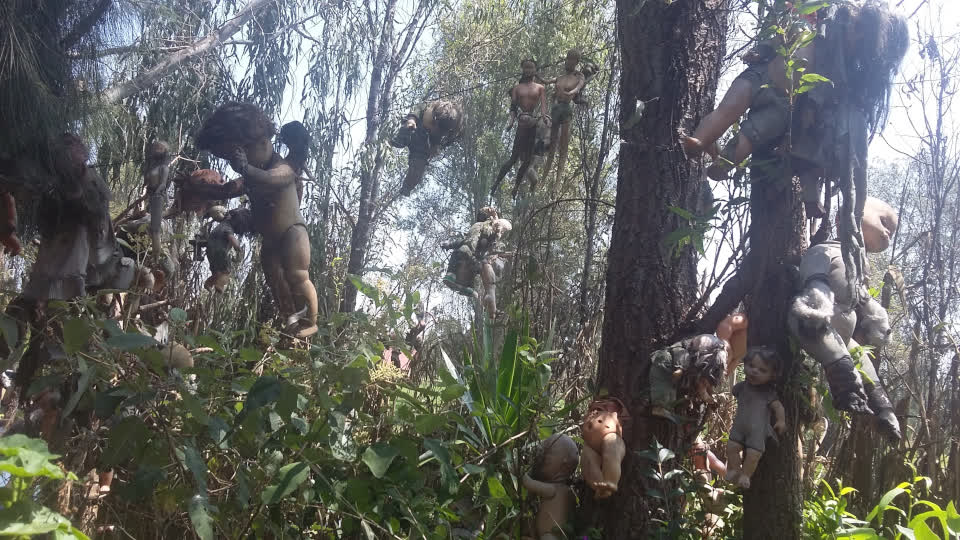
Isla De Las Munecas . The Doll Island Of Mexico
Isla de las Munecas sounds harmless when translated literally: “Island of the Dolls.”
The reality feels profoundly unsettling.
Hundreds of damaged dolls hang from trees across the island. Some are missing eyes. Others have cracked faces, dirt-covered limbs, or tangled hair moving in the wind. Humidity and rain have slowly distorted them over decades, making the island look less like an attraction and more like a psychological experiment abandoned halfway through.
The origin story matters.
According to local accounts, the island’s caretaker believed a young girl drowned nearby. To honor her spirit — or perhaps calm it — he began collecting dolls and hanging them throughout the island. Over time, the collection expanded uncontrollably.
Travel videos often exaggerate the supernatural angle. What they discuss less is the emotional atmosphere.
The island feels sad before it feels frightening.
That distinction changes the experience completely.
Bubblegum Alley . America’s Strangest Public Wall
At first glance, Bubblegum Alley sounds ridiculous rather than creepy.
An alley covered entirely in used chewing gum should feel playful. Instead, many first-time visitors react with discomfort. The walls pulse with decades of human residue layered in bright colors, random messages, hardened textures, and strange shapes formed accidentally over time.
The alley began developing in the 1970s and gradually transformed into one of California’s strangest unofficial landmarks.
Media coverage usually frames it as quirky street culture.
Less discussed is how physically overwhelming the space feels in person. The smell becomes intense during warm afternoons. Narrow sections trap sound oddly. Visitors alternately laugh and recoil while taking photographs.
One reviewer online described it perfectly:
“It felt like walking through someone else’s bizarre collective memory.”
That sentence captures the psychology of Bubblegum Alley better than any tourism slogan could.
The Hair Museum Of Avanos . Turkey’s Most Unsettling Collection
There are unusual museums, and then there is Avanos Hair Museum.
Located beneath a pottery workshop in central Turkey, the museum contains thousands of hair samples hanging from cave walls and ceilings. Different colors, lengths, textures, and handwritten notes create an environment that feels suspended somewhere between folk art, obsession, and horror cinema.
Photographs online rarely communicate how claustrophobic the underground space feels.
Hair is deeply personal. Seeing enormous quantities of it detached from human identity creates immediate psychological tension. Visitors instinctively search for meaning inside the collection even when no clear explanation exists.
And this is where travel becomes more interesting.
The museum forces travelers to confront how context changes emotion. Hair inside a salon feels ordinary. Hair covering cave walls feels disturbing.
Same object. Different setting.
Things The Media Doesn’t Tell You
Most social media content about creepy destinations follows a predictable formula:
Fast music. Shock reactions. Clickbait thumbnails. Fake paranormal claims.
That approach simplifies places that are often culturally or historically complex.
Travelers planning to visit unusual attractions should gather “real data” before arriving:
- Read recent negative reviews discussing crowd levels or sanitation
- Visit Reddit and Facebook travel groups for firsthand experiences
- Watch unedited YouTube walkthroughs instead of cinematic montages
- Search TikTok videos uploaded during regular weekdays, not Halloween events
- Look for local commentary rather than only tourist reactions
Why does this matter?
Because creepy tourism often looks very different in person.
Some attractions feel commercialized rather than frightening. Others become emotionally heavier than expected. Certain locations involve strong smells, narrow underground passages, or intense religious environments that casual travel blogs rarely explain properly.
Planning psychologically matters as much as planning logistically.
Capuchin Catacombs . Where Death Stops Feeling Abstract
Capuchin Catacombs is not designed to comfort visitors.
More than eight thousand preserved bodies line underground corridors beneath Palermo. Many remain dressed in formal clothing. Some appear almost asleep behind glass enclosures. Others have deteriorated into skeletal figures still standing against stone walls.
The first emotional reaction is usually shock.
The second is silence.
Unlike horror-themed attractions built for entertainment, the catacombs confront visitors with mortality directly and without decoration. Families once visited relatives here. Preservation reflected social status, religion, memory, and identity rather than tourism.
Modern Instagram culture struggles with places like this.
Some travelers treat the catacombs respectfully. Others approach them as visual content. That tension creates ethical questions rarely discussed in tourism marketing.
Should every historical site become a photo backdrop?
The catacombs quietly force visitors to decide for themselves.
Karni Mata Temple . Fear Depends On Culture
Karni Mata Temple may be one of the clearest examples of how culture shapes fear.
Known internationally as the “Rat Temple,” the site houses thousands of freely moving rats protected and fed by worshippers. Foreign visitors often react with immediate discomfort, especially when rats run across bare feet inside the temple complex.
Yet local religious interpretation differs entirely.
The rats are not viewed as contamination or horror. They are connected spiritually to reincarnation and sacred belief. Devotees move calmly through spaces that many international travelers find overwhelming.
This contrast matters deeply in travel writing.
Fear is not universal.
What one culture interprets as sacred, another may interpret as disturbing. Experienced travelers learn to pause before judging unfamiliar practices through their own cultural reflexes.
That pause changes everything.
Paris Beneath Paris
Most travelers know Paris through cafes, museums, fashion, and architecture.
Fewer think about what exists underneath the city.
Paris Sewer Museum reveals an underground infrastructure that inspired sections of Victor Hugo’s Les Miserables. Walking through these tunnels feels strangely cinematic. Metal walkways echo with dripping water while old engineering systems expose the hidden machinery supporting one of the world’s most photographed cities.
The unsettling aspect is not horror in the traditional sense.
It is realization.
Cities depend on invisible systems most tourists never think about. Sewers, tunnels, maintenance corridors, and underground networks rarely appear in travel campaigns, yet they shape urban life completely.
Paris becomes more human underground than above it.
Why Travelers Keep Returning To Disturbing Places
People often assume creepy destinations exist only for thrill-seekers.
That explanation is incomplete.
These places attract visitors because they interrupt emotional routine. They provoke curiosity instead of passive admiration. Travelers stop behaving like consumers and start reacting instinctively.
Some feel uneasy. Others become fascinated. Many experience both simultaneously.
And unlike perfect beaches or luxury resorts, unsettling places tend to remain emotionally vivid years later.
Not because they were comfortable.
Because they were impossible to ignore.
Exploring The Creepiest Museums And Temples On Earth.
dark tourism, creepy destinations, horror tourism, Doll Island Mexico, Bubblegum Alley, Capuchin Catacombs, Rat Temple India, Paris Sewer Museum, strange museums, creepy travel spots, unusual tourism, haunted attractions, underground catacombs, scary travel places, weird destinations
