
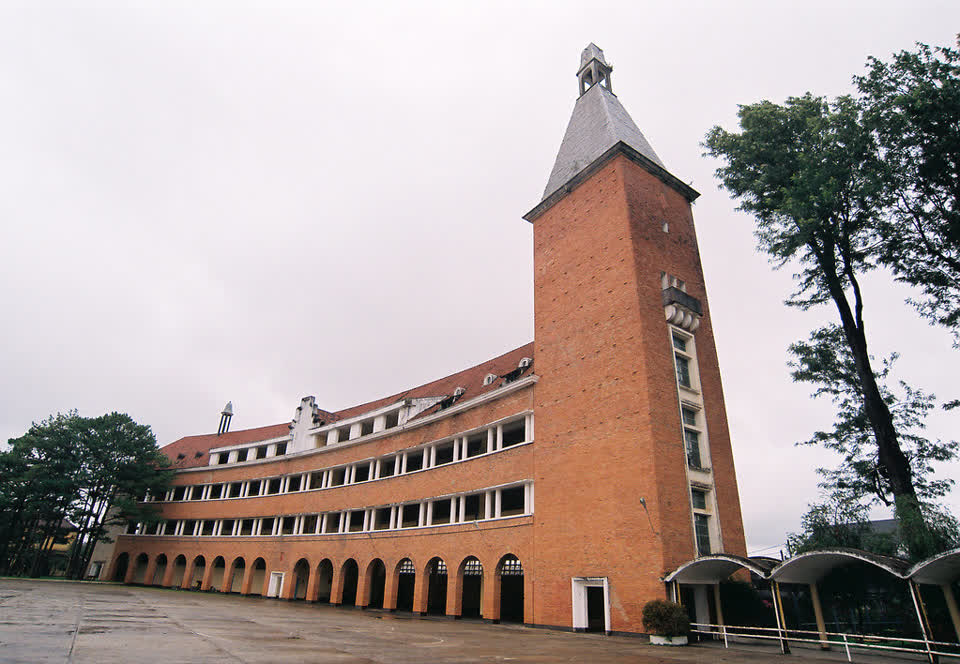
Da Lat Pedagogical College, originally founded by the French in 1927, has evolved from an elite colonial boarding school into one of Vietnam’s most recognizable architectural landmarks. Located near Xuan Huong Lake in Da Lat, the campus attracts photographers, architecture enthusiasts, couples taking wedding photos, and travelers searching for a quieter side of the city beyond coffee shops and flower gardens. Known for its sweeping curved classroom block, imported European bricks, and 54-meter bell tower, the school reflects a rare blend of French urban planning and local highland atmosphere. The campus was recognized as a National Architectural Heritage Site in 2001 and remains one of the few educational buildings in Southeast Asia listed among the world’s notable 20th-century architectural works.
The School That Tourists Visit Before They Understand Why
There are places in Da Lat that announce themselves loudly. Night markets. Cafes with cloud-hunting decks. Instagram gardens with painted doors and artificial props.
Then there is Da Lat Pedagogical College.
At first glance, it does not seem designed for tourism at all. It is, after all, still a functioning educational institution. Yet almost every traveler who spends more than two days in Da Lat eventually hears the same sentence from a local driver or cafe owner:
“You should stop by the old French school near Xuan Huong Lake.”
The campus sits quietly in Ward 10, not far from the center of Da Lat. Pine trees soften the edges of the property. The red-brick facade curves slowly across the hillside like an opened book. In the early morning fog, the building feels less like a school and more like a railway station from another century.
That ambiguity is exactly why people keep coming.
A French Colonial School That Outlived Empires
The school was established in 1927 during the French colonial period under the name Petit Lycée Dalat. Construction reportedly took eight years. It was designed by architect Moncet and initially served the children of French families and wealthy Vietnamese households.
Later, the institution became Grand Lycée de Dalat and then Lycée Yersin, named after Alexandre Yersin, the Swiss-French physician associated with the founding and scientific development of Da Lat.
Today, the campus is known as Da Lat Pedagogical College.
Yet despite the name changes, much of the architecture has remained remarkably intact since the late 1940s.
One travel historian once described buildings like this as “colonial memory preserved through practical use rather than museum restoration.” That feels accurate here. The school still functions. Students still walk the corridors. Teachers still move between classrooms. Nothing has been frozen for tourists.
And that is what gives the campus authenticity.
The Curved Building Everyone Photographs
Most visitors arrive for one reason: the curved lecture hall.
The structure stretches in a long arc, with different measurements at the front and rear facades, creating a visual effect that shifts depending on where you stand. Some compare it to an opened book. Others say it resembles a railway carriage bending through the hills.
Either way, the building refuses symmetry.
In an age of glass towers and interchangeable hotels, this architectural confidence feels refreshing.
The red bricks were imported from Europe. The roof tiles came from France. Yet the layout responds naturally to Da Lat’s cooler climate and rolling terrain. Open corridors allow airflow. Arched details soften the heavy brickwork. The building never appears aggressive against the surrounding pine-covered landscape.
Many travelers are surprised to learn that the World Union of Architects (UIA) recognized the school as one of the world’s notable 20th-century architectural works.
That recognition matters because Southeast Asian educational buildings are rarely included in global architectural conversations dominated by Europe or North America.
The Bell Tower That Defines The Skyline
At the end of the curved classroom block stands the bell tower.
Fifty-four meters high.
You can spot it from different parts of Da Lat, especially during clear mornings after rain. The tower creates a vertical counterbalance to the horizontal curve of the main building. Without it, the campus might feel elegant but incomplete.
Architecturally, it serves more than decorative purposes. Symbolically, it reflects the educational ambition of the era — a visible monument to learning placed above the fog line of a mountain city.
Older residents of Da Lat still remember when the tower dominated the skyline before modern hotels multiplied across the hills.
Now, ironically, tourists photograph the tower as if it belongs to a forgotten Europe, even though it has become deeply tied to Vietnamese urban identity.
Things The Media Doesn’t Tell You
Most articles describe Da Lat Pedagogical College as a romantic photography location. That is true, but incomplete.
Here are the details planners and experienced travelers usually care about:
1. Access Can Change
Because this is an active school, visitor access is sometimes restricted during exams, ceremonies, or weekdays with heavy student activity. Some travelers arrive expecting unlimited entry because of TikTok videos filmed years earlier.
That assumption causes frustration.
Before visiting, check recent Google Maps reviews, Facebook travel groups, or recent YouTube vlogs uploaded within the last month. Conditions change more often than travel articles admit.
2. Midday Light Is Bad For Photography
The campus photographs best early in the morning or late afternoon. Midday sunlight flattens the texture of the red brick and creates harsh shadows under the arches.
Professional wedding photographers in Da Lat often arrive before 8 AM for this reason.
3. It Is Smaller Than Social Media Makes It Look
Wide-angle drone footage can create the impression of a massive university complex. In reality, the landmark area is relatively compact. You can explore the main architectural highlights fairly quickly.
The value lies in atmosphere, not scale.
4. Respect Matters Here
This is not an abandoned French ruin converted into a tourist attraction. Students study here. Some travelers forget this and treat the campus like a film set.
Locals notice.
Quiet behavior and respectful photography go a long way.
5. Rain Changes Everything
Da Lat weather shifts quickly. Fog and light rain can dramatically improve the mood of the campus. On clear days it feels elegant. During misty mornings, it feels cinematic.
Travel planners who understand Da Lat often leave room for flexible scheduling instead of forcing rigid itineraries.
A Campus Built Between Europe And The Highlands
What makes the school memorable is not simply “French architecture.”
Vietnam has many colonial buildings.
What makes this campus different is how successfully it adapts imported European design into the rhythm of Da Lat itself.
The pine forests surrounding the property soften the geometry. The cooler mountain climate suits the brick construction naturally. Even the large open courtyard feels designed for reflection rather than display.
The building belongs to Da Lat now.
Not Paris. Not Lyon. Not Geneva.
And unlike many colonial-era structures converted into luxury hotels or government offices, this one still serves education. That continuity changes how people emotionally experience the space.
You are not walking through preserved nostalgia. You are walking through living history.
Community Voices And Traveler Impressions
In travel forums and photography groups, reactions to the school tend to repeat several themes:
“It feels more European than expected, but somehow still very Vietnamese.”
“The curves of the building look different every ten steps.”
“I thought it would be overrated until the fog rolled in.”
“It’s one of the few places in Da Lat where you can hear birds instead of karaoke speakers.”
Interestingly, architecture enthusiasts often enjoy the campus more than checklist tourists.
People searching for adrenaline usually spend less than thirty minutes here.
People interested in urban history, design, photography, or educational heritage often stay much longer.
Planning A Better Visit
If you want to combine the school into a broader Da Lat itinerary, pair it with nearby slower experiences rather than crowded attractions.
Good combinations include:
- Xuan Huong Lake walks
- Early morning coffee shops near Ward 10
- Old railway station visits
- Pine forest drives
- Quiet bakeries in central Da Lat
- Local markets during rainy afternoons
The school works best as part of a reflective day rather than a rushed “10 attractions in 6 hours” schedule.
That is the paradox of Da Lat itself.
The city rewards people who slow down.
Why This School Became A Tourist Landmark
Many cities have famous museums. Some have iconic cathedrals. Da Lat somehow turned a teacher-training college into one of its defining visual symbols.
That could only happen in a city shaped by fog, altitude, French planning, and decades of layered memory.
People come for photographs.
But most leave remembering the silence of the corridors, the cold air moving through the arches, and the strange feeling that education itself once carried the same grandeur cities now reserve for luxury hotels.
And perhaps that is why the building continues to resonate long after the cameras are put away.
Da Lat Through A Different Lens . The Campus That Looks More European Than Tropical Vietnam.
Da Lat Pedagogical College, Da Lat architecture, Lycée Yersin, Da Lat travel guide, French architecture Vietnam, Da Lat photography, Xuan Huong Lake, Da Lat heritage site, colonial buildings Vietnam, Da Lat attractions, Vietnam architecture tour, Da Lat school, romantic Da Lat, historic Da Lat, Da Lat travel tips
