
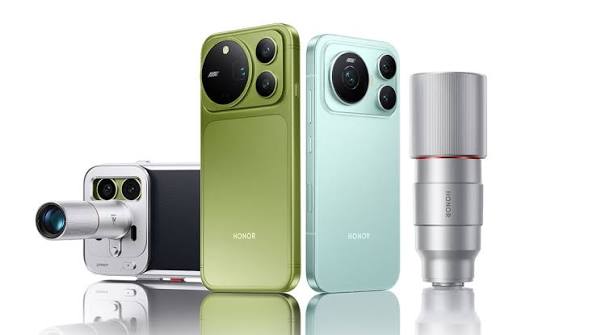
Honor Magic 9 Pro Max Brings ARRI Cinema Technology to Smartphones With 200MP Cameras
For years, smartphone companies have competed over megapixels, zoom capabilities and artificial intelligence. But Honor is trying something different with its new Magic 9 Pro Max.
China's Honor Uses Germany's ARRI Expertise to Compete in Premium Smartphones
Instead of simply promising sharper photographs, the Chinese smartphone manufacturer wants its newest flagship to become a serious filmmaking tool.
Its latest partnership with German cinema camera manufacturer ARRI brings professional-inspired color processing, Log video recording and cinematic image profiles to a smartphone. The device also introduces two 200-megapixel cameras and a dedicated imaging processor.
The message is clear. Honor does not just want to sell another expensive smartphone. It wants to sell a mobile production studio.
That ambition matters because the smartphone market is changing. People are increasingly using their phones to produce advertising, social media videos, product demonstrations and even professional-looking short films.
For smaller businesses and independent creators, the question is no longer simply which phone takes the best picture. It is which device can help them produce professional content without paying for an entire production team.
Honor and ARRI Bring Professional Cinema Technology Into a Smartphone
Honor's Magic 9 Pro Max is the first proper flagship smartphone to benefit from its partnership with ARRI, following the earlier Robot Phone.
ARRI is a German cinema technology company best known for its Alexa camera systems, which have been used in major Hollywood productions. At least six films shot using its cameras have gone on to win Academy Awards for cinematography.
This partnership gives Honor something different from the usual smartphone marketing message.
Instead of competing only on hardware specifications, Honor is connecting its brand to an established professional filmmaking ecosystem.
The Magic 9 Pro Max is launching first in Malaysia.
LAUNCH PRICE
RM 5,999
Approximately US$1,455
Memory
12GB RAM
Storage
512GB
First market
Malaysia
Next markets
Middle East, then Western markets
The company plans to expand into the Middle East the following month, with its first Western-market launch expected in January.
The price places the device firmly in the premium smartphone category. Honor is asking customers to pay for more than a camera. It is selling a combination of hardware, imaging technology and professional creative tools.
The Magic 9 Pro Max Is Built Around a 200MP Dual-Camera System
The main attraction is the triple-camera system on the back.
Rear camera specifications
200MP main camera
f/1.57 aperture with optical image stabilization
200MP telephoto camera
f/2.6 aperture with optical image stabilization
50MP ultra-wide camera
f/2.0 aperture
Honor says its main camera offers gimbal-level optical stabilization.
In simple terms, stabilization helps keep video smooth when the person recording is walking, moving or holding the phone without a tripod.
This is particularly useful for social media creators, independent filmmakers and businesses producing promotional videos.
The company has also introduced its first dedicated imaging processor, called the H1.
This is an important development because smartphone photography is not determined by camera sensors alone.
The sensor captures the image, but the processing system helps determine how colors, light, details and movement appear in the final result.
Honor is attempting to control more of that process through its own imaging technology and its collaboration with ARRI.
ARRI LogC3 and 87 Cinema Looks Target Professional Video Creators
The biggest difference is not necessarily the number of megapixels.
It is the video workflow.
The Magic 9 Pro Max supports ARRI LogC3, a professional-style Log recording format designed to preserve image information for color grading.
For ordinary users, Log footage can initially look flat and less colorful than standard smartphone video.
But that is intentional.
It gives editors more flexibility when adjusting brightness, contrast and color during post-production.
Honor also includes up to 87 ARRI-created visual looks and color profiles.
Users can apply these styles to footage to create different cinematic appearances without having to build every color adjustment manually.
The phone also supports a 2.39:1 cinema aspect ratio, a widescreen format commonly associated with theatrical filmmaking.
This matters because the company is moving beyond the traditional smartphone camera experience.
A normal phone camera is designed to make photographs and videos look attractive immediately.
A filmmaking camera is designed to give creators greater control over the final result.
Honor wants to bring elements of that second approach to mobile devices.
However, ARRI-inspired color tools do not automatically make smartphone footage equivalent to footage from a professional cinema camera. Sensor size, optics, dynamic range, recording formats and production conditions still matter.
The real value is making more advanced creative control accessible in a smaller device.
SmallRig Accessories Turn the Smartphone Into a More Complete Production System
Honor is also working with SmallRig, a company known for camera accessories and production equipment.
The partnership introduces a camera cage that allows users to attach additional equipment to the smartphone.
Two teleconverter accessories are also part of the system.
Honor Teleconverter G200
200mm
Extends the phone's focal-length capability.Honor Teleconverter G500
500mm
Designed for more distant subjects.The accessories are particularly interesting because they extend the product beyond the phone itself.
A creator can attach the smartphone to a cage, add external equipment and use additional teleconverters to capture distant subjects.
This creates a more complete mobile production setup.
It also reveals something important about Honor's strategy.
The company is not just selling a device. It is trying to establish an ecosystem of accessories and creative tools around that device.
That is a more defensible business strategy than competing on megapixels alone.
The Hardware Is Designed to Support Long Creative Sessions
The camera system receives most of the attention, but the remaining specifications are also designed for premium users.
|
Feature |
Magic 9 Pro Max |
|---|---|
|
Processor |
Snapdragon 8 Elite Extreme Gen 6 |
|
RAM |
12GB or 16GB |
|
Storage |
256GB, 512GB or 1TB |
|
Display |
6.8-inch LTPO OLED |
|
Resolution |
2,868 × 1,320 |
|
Refresh rate |
1–120Hz |
|
Peak brightness |
10,000 nits |
|
Battery |
8,000mAh |
|
Wired charging |
Up to 100W |
|
Wireless charging |
Up to 80W |
|
Connectivity |
Wi-Fi 7 |
|
Front camera |
55MP |
The 8,000mAh battery is particularly relevant.
Recording high-quality video, editing footage and using demanding camera features can consume significant amounts of power.
A large battery helps support longer creative sessions.
The 100W wired and 80W wireless charging also reduce the time required to recharge the device.
The phone uses a new industrial design first introduced on Honor's lower-end N series models. It also introduces the Pro Max naming convention to Honor's flagship range.
The combination of a premium design, large battery, advanced cameras and professional video features shows that Honor wants to position this device as a complete creative workstation that fits in a pocket.
How Honor Can Make Money From the Creator Economy
The commercial opportunity goes beyond selling expensive smartphones.
The global creator economy has created demand for equipment that is powerful, portable and relatively easy to use.
A small marketing agency may need to produce several videos every week. An independent creator may need to record product reviews, interviews and travel content. A small retailer may want professional-looking advertisements without hiring a production company.
These customers represent a growing market.
Honor can create value through several connected business areas.
Premium smartphone sales
The Magic 9 Pro Max is priced at approximately US$1,455 for the 12GB RAM and 512GB storage version.
This gives Honor an opportunity to compete in the premium market, where customers are willing to pay more for specialized features.
Accessory sales
Camera cages, teleconverters and additional production equipment create opportunities to generate revenue beyond the original smartphone purchase.
Brand partnerships
Working with established companies such as ARRI and SmallRig strengthens Honor's position in the professional creator market.
These partnerships also help reduce the distance between consumer electronics and professional production equipment.
Customer loyalty
If creators build their workflow around a particular smartphone, its accessories and editing tools, they may be more likely to remain within that ecosystem when upgrading.
The larger business opportunity is turning a one-time smartphone purchase into a longer-term relationship with customers.
The Risks Behind Honor's Hollywood Strategy
The partnership with ARRI is valuable, but it does not guarantee commercial success.
There are several challenges.
Professional branding creates high expectations.
Customers may expect cinema-camera quality simply because ARRI is involved.
But a professional camera system and a smartphone have different physical limitations.
The partnership can improve the workflow, but it cannot remove every limitation of smartphone hardware.
The price is a major barrier.
At approximately US$1,455, the Magic 9 Pro Max is expensive.
Many creators may prefer a cheaper smartphone combined with an existing camera or professional accessories.
Accessories increase the total cost.
The camera cage and teleconverters may make the system more capable, but they also create additional purchasing decisions.
The software experience must deliver.
Professional color profiles and Log recording are useful only if the camera software, file handling and editing workflow are reliable.
Creators need a system that works consistently, not just impressive specifications.
Global competition remains intense.
Apple, Samsung and Chinese smartphone manufacturers are all competing for premium customers.
Honor needs to prove that its ARRI partnership creates a meaningful advantage rather than a temporary marketing headline.
The US-China Technology Divide Creates a Different Opportunity for Honor
The smartphone market is also part of a larger technology competition between the United States and China.
American companies have strong positions in operating systems, software ecosystems, semiconductor design and global services.
Chinese manufacturers have developed significant strengths in hardware production, manufacturing scale, camera systems, battery technology and supply-chain execution.
Honor's strategy illustrates how Chinese companies can compete through specialization and partnerships.
Instead of trying to win every part of the smartphone market, Honor is building a distinct position around mobile photography and filmmaking.
ARRI brings professional imaging knowledge from Germany. SmallRig adds accessory expertise. Qualcomm provides the smartphone processor platform.
This is an example of a global technology supply chain creating a differentiated product across several countries and industries.
However, businesses should not assume that every partnership will remain unaffected by geopolitical tensions, export restrictions or changing technology policies.
For companies operating across international markets, supply-chain flexibility and access to multiple technology providers remain important.
What Small and Medium-Sized Businesses Should Learn From Honor
The most useful lesson is not that every business needs an expensive smartphone.
It is that technology can create new capabilities when different products and services work together.
A small business does not need a Hollywood production budget to produce effective marketing.
It needs a clear content strategy and the right production workflow.
For example:
-
A restaurant can produce short videos showing food preparation and customer experiences.
-
An online retailer can create product demonstrations without hiring a large production team.
-
A small manufacturer can record product testing and technical demonstrations.
-
A marketing agency can produce more content using fewer production resources.
-
An independent consultant can create educational videos to build trust with customers.
The smartphone is only one part of the system.
Lighting, sound, storytelling, editing and distribution still matter.
A business that spends thousands of dollars on camera equipment but has no clear marketing strategy will not automatically generate more sales.
The technology must support a business objective.
If I Were Running a Small Business, This Would Be My Strategy
I would not immediately spend US$1,455 on a smartphone simply because it has an ARRI partnership.
I would first calculate how much video production contributes to revenue.
If video is an important sales channel, I would build a simple production system.
Start with products and customer stories.
Produce short videos demonstrating what the business sells, how products work and why customers should care.
Create repeatable production workflows.
Instead of recording randomly, establish a weekly schedule for product videos, customer education and promotional content.
Invest in the weakest part of production.
If the image is poor, improve the camera or lighting. If customers cannot hear clearly, invest in audio equipment. If videos receive little engagement, improve the storytelling.
Do not buy expensive equipment before understanding the actual problem.
Measure commercial results.
Track how many inquiries, website visits and sales come from video content.
The objective is not to create beautiful videos for their own sake. It is to generate measurable business value.
Upgrade only when the business needs it.
If a smartphone such as the Magic 9 Pro Max can replace part of an existing production workflow, its premium price may become easier to justify.
But if a cheaper device already produces sufficient results, the additional investment may not be necessary.
Conclusion — Smartphones Are Becoming Creative Production Platforms
Honor's Magic 9 Pro Max represents an interesting development in the premium smartphone market.
Its partnership with ARRI brings professional-inspired video workflows, LogC3 recording and up to 87 cinematic looks to a mobile device.
The two 200MP cameras, dedicated H1 imaging processor, 8,000mAh battery and SmallRig accessories strengthen its position as a tool for serious mobile creators.
But the larger story is about the direction of the smartphone industry.
Hardware companies are moving beyond the traditional competition over processing power, camera megapixels and screen quality. They are trying to build complete ecosystems around specific customer needs.
Honor has chosen filmmaking and the creator economy.
For small businesses, the opportunity is straightforward. Professional-looking content is becoming more accessible, and the cost of producing marketing material may continue to fall.
The companies that benefit most will not necessarily own the most expensive equipment.
They will be the ones that turn technology into better products, stronger customer relationships and more sales.
ARRI and Honor Join Forces to Bring Professional Film Colors to Mobile Video
Honor Magic 9 Pro Max, ARRI cinema camera, smartphone filmmaking, mobile cinematography, 200MP camera, ARRI LogC3, Honor H1 processor, creator economy, mobile video production, SmallRig accessories, Chinese smartphones, premium smartphones, AI photography, smartphone camera technology
